
UK Government Strategies During 2025
Elcern Consulting looked at the broad range of strategy documents the government published during 2025 on technology. Our aim was to help organisations be aware of and locate government priorities that may be relevant. We set our findings out in the form of a timeline, and along the way drew some insights we think organisations and even government may find useful. We think that deeper understanding of those strategies, how they interlink and the opportunities they offer organisations should benefit innovation, economic value and growth.
Overview
Overall, across the first 12 months of the new government, we found 19 strategy documents published within a broad scope area of digital technology and supporting services.
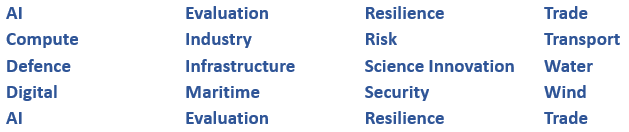
For Elcern, digital technology strategy during 2025 encompassed AI, digital, technology, infrastructure and innovation. And in our view, success in those primary areas depended on additional strategies iin support areas like energy, resilience, risk, security, transport and water. For example, an AI strategy would be hard to implement if its electricity and materials supply, security, its impact on national resilience and water supply, and how workers get transported were not considered. (see table of the categories of strategy documents issued during 2025)
2025 Timeline
Looking across the year on a monthly basis, we saw June and July were by far the busiest months for publications, with the more typical rate being 1-2 per month
Three key strategy documents published in January kicked the year off: the AI Opportunities Action Plan (AIOAP), the National Risk Register and the Blueprint for Digital Government.
February was comparatively quiet with just the DSIT Evaluation Strategy
March saw publication of the Maritime Decarbonisation Strategy.
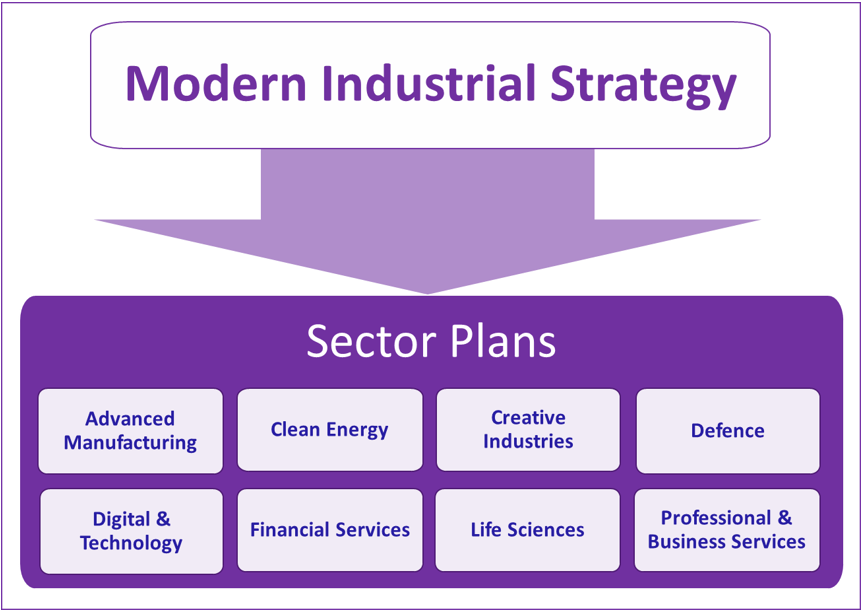
June’s 14 strategy publications dominated the year. Crucial amongst them was the Modern Industrial Strategy along with 5 of its Sector Plans (for Advanced Manufacturing, Clean Energy, Creative Industries, Digital/Technology and Professional/Business Services). And arguably, the second most important strategy in June was the UK Infrastructure Strategy. The Strategic Defence Review, Security Strategy, Solar Strategy, Trade Strategy, Transportation AI Strategy and the Water Framework rounded out June.
July proved to be the second busiest month for strategy document. It saw the Modern Industrial Strategy evolved by issue of two sector plans (Financial Services and Life Sciences). Clean energy featured with 2 strategy documents (Onshore Wind Strategy and the Clean Flexibility Roadmap (electricity)). Rounding out July were the UK Compute Roadmap, and the UK Resilience Action Plan
A good gap ensued to September when the evolution of the Modern Industrial Strategy: was completed by issue of the Defence Sector Plan.
The year rounded out for us in November with the Critical Minerals Strategy
That’s not to say there weren’t more strategy documents issued. But for us, the above timeline set the scene for 2025 in areas such as AI, digital and technology and their supporting areas of energy, resilience.
Topics in Focus
Across the year we saw government focus areas included: AI, digital, infrastructure, innovation and technology. We also saw strategies that supported success in those focus areas such as energy and water, manufacturing, resilience, risk, security and transport. A range of these are discussed below.
-------------------- AI --------------------
AI featured twice in headline government strategies during 2025.
The AI Opportunities Action Plan (AIOAP) stood out as one of the most notable recent strategy developments. Its 50 recommendations aimed at creating world-class infrastructure, talent and regulation, drive increased adoption and partner practical home-grown AI applications.
Establishing AI Growth Zones around the country was a key action of the AIOAP. Such Zones were to benefit from streamlined planning approvals process along with accelerated provisioning of clean power. The Zones could then attract private capital and drive local rejuvenation and jobs.
Elcern Consulting's perspective was that AIGZs signal a UK opportunity to build growth in local supply chains, and in AI ecosystems that may build out the economic opportunities. Alongside the 10 or more UK hyperscale data centre investments announced mainly by US operators, these planned AIGZs may bring one of the great concentrations of data centres in the world (see insert of extracts of the UK Government’s AI Plan).
A second AI focus was the Transportation AI Strategy with 23 actions to revolutionalise transport through AI. It aimed deliver safer, greener, and more efficient mobility with significant economic, social, and environmental benefits.
-------------------- Manufacturing --------------------
The Modern Industrial Strategy was another landmark development during 2025.
Along with its 8 underpinning Sector Plans, it aimed to stimulate growth and investment in specific priority sectors (see figure 1). Each sector plan was further underpinned by multiple frontier industries.
The whole document framework runs to nearly 850 pages by our count. And tracking the hundreds of individual actions could prove onerous and tricky without comprehensive tabular summaries.
In Elcern Consulting's view, the Advanced Manufacturing Sector Plan specifically, is somewhat let down by typos.
Additional components of the Modern Industrial Strategy are the Industry Zone Action Plans. These bring together government actions for Freeports, Investment Zones and Enterprise Zones.
Elcern Consulting considers that organisations could access the document set by identifying their closest frontier industry, map to the relevant Sector Plan and then home in on where government funding and policy support might help. For example, an aerospace manufacturing organisation could look to the Aerospace frontier industry under the Advanced Manufacturing Sector Plan. That gives 3 government policy areas that could be aligned to: Aerospace Technology Institute, Future of Flight programme and the Sustainable Aviation Fuel Mandate; any of which may benefit the organisation.
-------------------- Infrastructure --------------------
Government aimed the Infrastructure Strategy at working alongside its Modern Industrial Strategy. Most of the critical national infrastructure components featured ie transport, energy, water, waste, and digital. These sat alongside flood risk management, housing and social infrastructure.
The Infrastructure Strategy developed along three themes:
- New governance
- Funding
- Delivery reforms
Within its governance theme, the creation of the National Infrastructure and Service Transformation Authority gave a new centre of expertise to government governance over infrastructure projects. Various funding opportunities were identified within the second theme. And finally, planning reforms, supply chain resilience and upskilling the infrastructure workforce formed parts of the third theme.
Elcern Consulting holds the view that the strategy is weakened by its lack of a comprehensive list of actions that could be tracked, Also, it somewhat overlapped with other government strategies. For example, it included the funding for the AI Opportunities Action Plan (AIOAP) and specifically headed up AI Growth Zones; strategy steps already taken earlier in the year under the AIOAP itself.
Elcern Consulting also considered the scope of digital infrastructure somewhat limited to almost connectivity (such as Project Gigabit). Our view is currently that the Infrastructure Strategy missed the opportunity of addressing a cohesive assessment and action plan on the broader aspects of digital infrastructure such as data centres.
-------------------- Clean Energy --------------------
Clean energy was addressed by government during 2025, with individual strategy documents for wind (Onshore Wind Strategy, July) , solar (UK Solar Roadmap, June) and electricity flexibility (Clean Electricity Flexibility Roadmap ,July).
The UK Solar Roadmap specified over 60 actions to support the addition of 27-29 GW new generation.
The Onshore Wind Strategy specified over 40 actions from government and industry to help deliver up to 29 GW of onshore wind by 2030.
The Clean Flexibility Roadmap specified over 50 actions tackling consumer-led flexibility, grid-scale batteries, interconnection, long duration electricity storage, low carbon dispatchable power, markets, electricity networks, digitisation and smart data, planning and supply chains.
-------------------- Critical Minerals --------------------
The government's 2025 Critical Minerals Strategy stemmed from the lack of natural resources needed to support the country's wellbeing and growth. Its been clear for many years that without certain minerals many aspects of life would be severely impacts; aerospace engines couldn't be built or serviced; data centres couldn't be implemented and would gradually fail; EV cars wouldn't be possible; diagnostic tools wouldn't run. And recent geopolitical events put critical minerals supply ever more into the strategy spotlight.
The UK government's approach categorised minerals three ways: critical, both critical and growth and growth. Optimising domestic production and building resilient UK and global supply networks underpinned the approach. It set out a dynamic approach to monitoring vulnerabilities and adjusting where necessary.
In Elcern Consulting's view, the Critical Minerals Strategy is somewhat let down by typos.
As with the Infrastructure Strategy, Elcern Consulting holds the view the Critical Minerals Strategy is weakened by its lack of a comprehensive list of actions that could be tracked,
-------------------- Digital --------------------
Digital featured with 3 government strategy documents during 2025.
The Blueprint for Digital Government, Home Office 2030 Digital Strategy and the Digital/Technology Sector Plan under the Modern Industrial Strategy. The Blueprint set a 6-point plan, with by our count nearly 60 “interventions”, for DSIT to deepen digitization of modern digital government. Aligning with greater AI deployment across government along with its funding and partnership initiatives could result in important support to business growth. The Home Office’s 2030 Digital Strategy again featured AI, digital infrastructure, systems and skills in over 52 “we wills”.
Finally, the Digital/Technology Sector Plan created some repetition, for example with the AI Opportunities Action Plan when announcing AI Growth Zones.
-------------------- Risk --------------------
The UK government's National Risk Register (NRR 2025) showed the UK government’s assessment of nearly 90 of the most serious risks facing critical infrastructure.
Its detail aimed to help private owners and operators better prepare for severe events and crises.
Its coverage is pertinent to many UK organisations thinking about risks like loss of electricity, water supplies and communications, fire, flood, heatwaves, pandemic, strikes, cyber and physical security. For example, a UK data centre owner or operator has probably seen substations fires, pandemic forecasts, regional flooding, and ransomware attacks over the last year, not necessarily directing impacting them but incidents to consider in their risk processes.
Everyone is expected to play their part in building resilience against emergencies. And in Elcern's view, all risk and resilience professionals may benefit from periodically validating their own organisation’s risk assessment against the latest register
-------------------- Transport --------------------
Transportation featured twice, with the Transportation AI Strategy (as considered above) and the Maritime Decarbonisation Strategy (MDS).
The MDS includes a roadmap to lower maritime emissions for supply of critical materials to the UK. Opportunities that caught out eye included potential for maritime to be an early off-taker of clean power and for low carbon fuels like hydrogen to supply decentralised energy generation systems at ports. MDS also highlights marine service provision to government ambitions in delivery of solar and wind generation.
-------------------- Water --------------------
A key government water strategy document was the National Framework.
The Framework applies to England only, and is based upon a forecast public water supplies shortfall of 5 billion litres per day by 2055. The Framework estimates that initially 80% of the gap needs to be met by demand management, falling to 60% later towards 2055.
The Framework notes possible threats to water supply to homes and impact on energy supplies, as well as possible limits on food production. A risk of restricted economic growth may emerge as strategies like the Modern Industrial Strategy are implemented. Here Elcern is considering semiconductor fabrication, and some data centres, as examples of potential added water demands.
Challenges
- Landscape … Elcern avoided a comprehensive review of all government strategy documents and instead chose a technology-based scope as no landscape of all 2025 strategies is published by government. We would encourage the UK government to produce such landscapes from time to time to guide their own work, and also support understanding of the organisations impacted by such strategies.
- Terminology … Elcern saw various naming terms adopted by government across its 2025 strategy documents, such as plans, blueprints and roadmaps. Organisations need to sharpen searches accordingly to find all documents relevant to their interest area.
- Actions … Elcern observed widely different presentation of actions within the government’s strategy documents. Actions presentation ranged from summary tables, through distributed boxes to embedding them in the full flow of text with no summary. This makes viewing and tracking difficult, and we would encourage the UK government to adopt a common, consistent approach to the presentation of its commitments so that organisations can easily see what they may align to and track progress.
- Layout … Elcern observed widely differing document layouts, even within the same government department. While maybe encouraging innovative document approaches, that may complicate navigation and information searches. We would recommend government adopt a standardised layout in strategy documents to help small amd medium organisations access key information readily. We would encourage the UK government to adopt at least a core set of content headings to provide some commonality and consistency in the strategy documentation.
- Outcomes … While certain of the government strategy documents we assessed did declare outcomes, Elcern has a concern about gaps in continuity between successor strategies. So, we recommend that government declare the detailed outcomes of a strategy that is to face revision. That declaration could appear as one foundation for the revision. Indeed, Elcern considers it a condition that the detailed review of successes and failures of actions in a past strategy are declared as a foundation for a revision or replacement. Without outcomes being clearly communicated prior to new endeavours Elcern considers valuable lessons may be lost, and indeed the process of public funding strategic initiatives could be weakened.
- Complexities ... Elcern found the sheer amount of government documentation somewhat overwhelming along with several styles and content. Content typically lacked much communciation of the government's view of risks to strategy delivery. Trackable final action lists were missing from many. There were overlaps in initiatives such as AI across strategy documents. And Elcern considered the lack of a government landscape setting out the intended strategy coverage is a major blocker.
Hopefully our review encourages organisations to digest the government's 2025 strategy landscape and seek opportunities to benefit from it ... as well as watch out for fiurther government stratesgies during 2026
We Can Help
In summary the government delivered a lot of strategy documents during the first part of this year. And, we know there’s lots more to come.
Organisations aligning with the above government strategies through awareness of content, actions, opportunities may be able to achieve competitive or reputational advantage while simultaneously contributing to UK economic growth.
UK regions may also benefit by aggregating the regional priorities developed and mapped by some (though not all) of the strategy documents. In turn, each region can then integrate those priorities into their local development plans.
Elcern Consulting is a boutique management consultancy that supports organisations with strategy, business planning, risk management, compliance, business process mapping and training. Within our public sector practice, we maintain a database of 56 UK government strategy documents issued from 2020 to date. We monitor developments and can help organisations navigate and build out approaches to benefit from government strategies
Do reach out with comments, questions or requests for help in this fascinating field
Attributions: This article contains public sector information licensed under the Open Government Licence v3.0
Disclaimer: It is important to remember that our list does not attempt a comprehensive coverage of all pertinent strategies, frameworks or plans. Readers should always conduct their own research and draw their own conclusions from the original source documents.