
How Is the UK Doing with AI Growth Zones?

Elcern Consulting took a look at how AIGZs were conceived, where they are located, and consider some of their potential benefits. Our approach is as much a navigation aid for those working with AIGZs as it is a potted summary of where the sector has reached. It may also prove useful for organisations building their own playbook for AIGZs, as we have done.
Key aspects of our review are:
- The UK Government grasped the economic opportunity presented by AI, and specifically AI infrastructure by facilitating massive data centre investments
- Matching explosive demand with infrastructure has beome a key challenge in capturing and developing AI's economic advantages
- Developing business campuses around the vast new data centre investments were identified as the way forwards under a programme of AI Growth Zones (AIGZs)
- A set of AIGZ selection criteria, designed and communicated by government, have underpinned a process for developers to submit formal applications fpr assessment by government
- To end January 2026, the UK government has selected 5 AIGZs
- The selected AIGZs demonstrate a commitment to decentralise data centre capacity away from London and the South East
- A consequence of the selections is anticipated to be substantial regional economic growth from the investments, construction and operation of the innovative AIGZs
- Substantial further growth is anticipated from expansion of AIGZs once they have built foundational operations
Inspiration for AIGZs
Crucially, AIGZs sit at the heart of the government’s “Plan for Change” growth agenda, helping drive economic value, jobs and social wellbeing. Not only can the AIGZs be huge votes of confidence in their respective regions, but they may help make the UK the natural choice for siting new AI businesses.
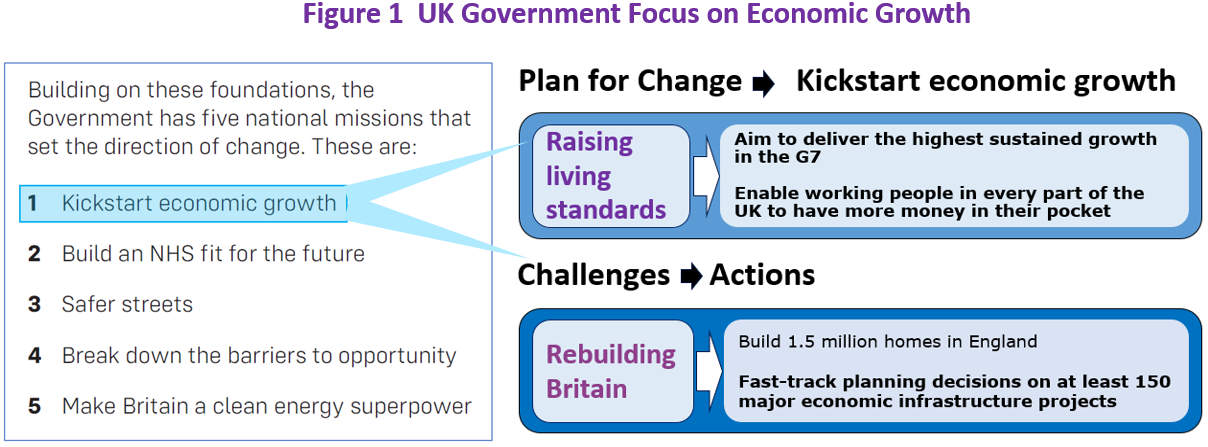
The drive for economic growth has been the aim of many UK governments and became the Number 1 Priority for the July 2024 UK government under its “Plan for Change”. Indeed, its “Kickstart Economic Growth” set challenges of delivering the highest sustained growth in the G7 and fast-tracking planning decisions (See Figure 1). Fundamentally though, the Plan For Change determined to harness the incredible potential of artificial intelligence to deliver on the five missions.
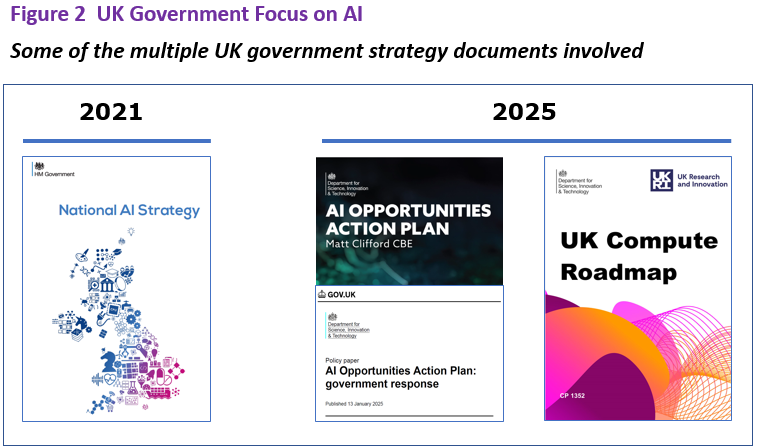
The 2021 National AI Strategy confirmed the huge potential in AI to drive economic growth. And it highlighted that alongside growth, AI could increase productivity, resilience, and innovation across both private and public sectors. That heady mix set AI’s foundations for the UK. Opportunities to explode AI use came to life during 2025, through both its January AI Opportunities Action Plan (AIOAP) and its July Compute Roadmap. (See Figure 2)
One aspect these strategy documents homed into was the dire need for a massive step change in UK AI digital infrastructure. With people increasingly using AI as a core part of their everyday life, whether at work or at home, data processing, storage, and communication rise massively. Explosive AI growth would be sustained when matched by increases in digital infrastructure e.g. data centres, substantial power supplies, fibre routes and so on. As that picture of AI demand growth and AI infrastructure additions is gradually expanded, the potential economic impact may be substantial.
Key AIGZ Actions
A key government step to find the balance between AI opportunity and investment was its July 2024 drive to develop an AI Opportunities Action Plan (AIOAP). That AIOAP produced 50 AI recommendations.
AIOAP recommendation 4 (AIOAP #4, Figure 3) tackled the mechanics for necessary infrastructure head-on. Measures to catalyse the much-needed data centre developments and associated services were proposed by creating AI Growth Zones (AIGZs) around the country. Those AIGZs could bring in much needed investment, and kickstart local economic growth. In turn, that was aimed at realising the potential highlighted in the government’s Plan for Change.
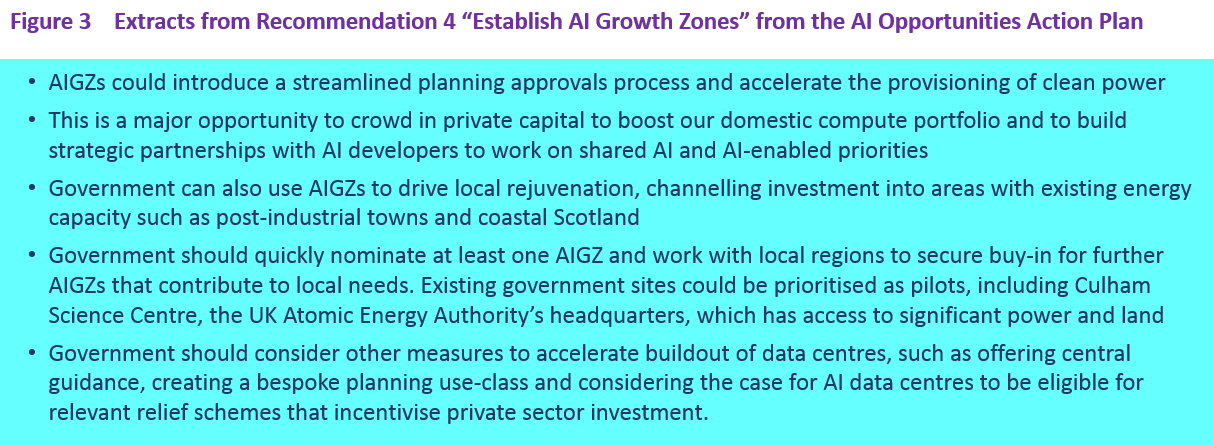
At its core, AIOAP #4 set out challenges of sourcing land, power supply and planning support for the huge facilities needed, all well-known blockers to data centre development in the UK in the past.
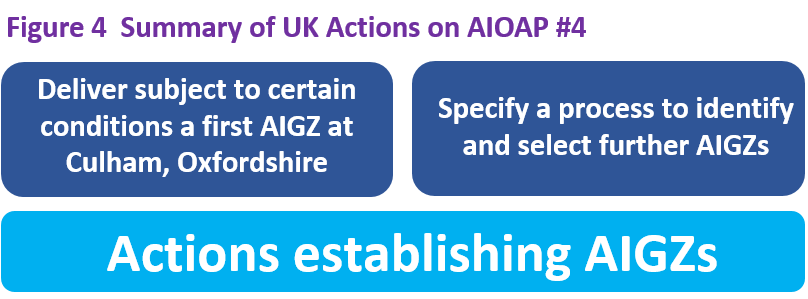
The government agreed actions for all 50 AIOAP recommendations. For AIOAP4, it actioned a first AIGZ for delivery at Culham in Oxfordshire. That was to be followed up by publishing a process by which further AIGZs could be selected for development (Figure 4)
The AIGZ Process
A two-stage process evolved. An Expression of Interest (EOI) step in February was followed by a formal application step in Spring 2025. EOIs from interested parties were to help inform AIGZ site selection and policy development, so government could move quickly. The formal application step invited UK local and regional authorities, and industry including energy companies and data centre developers to make development proposals for high-potential sites for AIGZs.
Technical, delivery, impact and support criteria were specified for prospective AIGZs to satisfy. Each headline criterion had several subcategories (indicated in Figure 4, but readers should follow the precise requirements of the government’s application call). Applicants were asked to support their with by specific evidence in each category.
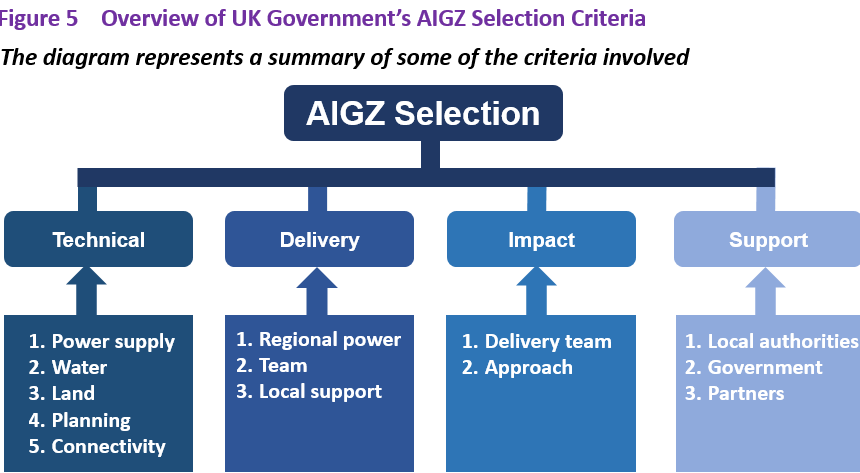
An aim of the AIGZs was to be large scale. To that end, minimum requirements included 100 acres of land available for the construction of AI infrastructure by 2028 and 500MW power capacity by 2030. In the past, most operating UK data centres were less than 100MW capacity.
AIGZ Selections
So far five AIGZs have been selected by government: in Culham (Oxfordshire), North--East England North and South Wales and most recently, Lanarkshire (Scotland) (see Figure 5).
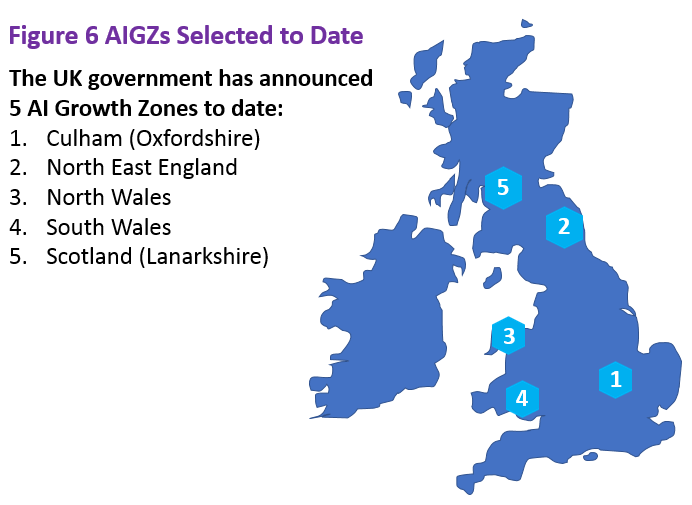
Their geographical distribution appears to us to add to a form of devolution (indicated in Figure 6). Only one AIGZ is relatively close to London, previously the heartland of UK data centres. And each AIGZ may cluster regional investments. Local workforces may grow steeply, and AI adoption step-change with the huge new anchor investments. Local economies may even boom from potential local supply chain growth and ecosystems of new AI innovators
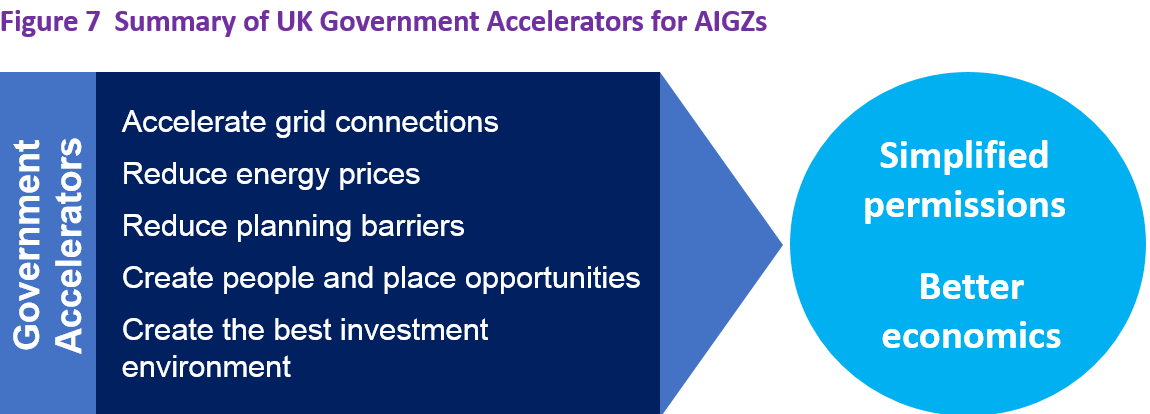
Crucially, a major boost to AIGZ implementation came with November’s government package of measures to speed and simplify planning processes and accelerate access to power at attractive prices (see Figure 7 outline). Readers should conduct their own analysis of that package. In our opinion, there is still much detail to be announced to implement it. And in our view, ongoing government consultations on changes to the National Planning Policy Framework and a National Policy Statement for Data Centres may well prove a crucial turning point in the next 3 months. and may be well worth contributing to if you are a UK data centre stakeholder.
Summary
Summarising this current research note, we’ve given our view of some origins of AIGZ, timelines, achievements, and some intended benefits. Supporting information is available, too lengthy to go into here, and we’ve provided a list of some useful source materials below.
In terms of our ongoing work, Elcern Consulting has been building views of the broader economic impact of AIGZs. For example, looking at integrations with Councils’ Local Development Plans, with the UK’s Modern Industrial Strategy and how AI ecosystems may develop.
We can help …. at Elcern, we dedicate a significant amount of time to analysing UK AI trends, digital infrastructure and regional economic growth and associated challenges. We review and examine a multitude of national and regional strategies, action plans, and blueprints to forge a deep understanding of how organisations can align to and benefit from AI growth. Our outline AIGZ analysis above hopefully indicates our aim to encourage organisations to analyse government data and relate it to their AI deployment strategies and decision-making.
Aligning your strategy with government priorities, needing trainng on AIGZs or on the broader UK government agends on AI ... contact us.
Suggested Sources for Further Reading
- National AI Strategy, HM Government. Version 1.2. Department for Digital, Culture, Media and Sport. September 2021
- AI Opportunities Action Plan, CP 1241, Matt Clifford CBE, DSIT, January 13, 2025
- AI Opportunities Action Plan: Government Response. Presented to Parliament by the Secretary of State Science, Innovation and Technology. CP 1242, January 13, 2025
- Government Fires Starting Gun On AI Growth Zones Turbocharge Plan for Change. Department for Science, Innovation & Technology. February 10, 2025
- UK Compute Roadmap. CP 1352. Department for Science, Innovation and Technology and UK Research and Innovation. July 17, 2025
- North-East set to become AI powerhouse as an AI Growth Zone – creating potential for more than 5,000 jobs and £30 billion in private investment. Department for Science, Innovation and Technology. September 16, 2025
- North-East AI Growth Zone taskforce to accelerate jobs, skills and growth. Department for Science, Innovation and Technology. September 24, 2025
- AI Growth Zones to create thousands of jobs and unlock up to £100 billion in investment, as new site confirmed for North Wales. Department for Science, Innovation and Technology, Wales Office, Prime Minister's Office, November 13, 2025
- Delivering AI Growth Zones. CP 1440. Department for Science, Innovation and Technology. November 2025
- AI to power national renewal as government announces billions of additional investment and new plans to boost UK businesses, jobs and innovation. HM Treasury, Department for Science, Innovation and Technology, Wales Office. November 20, 2025
DISCLAIMER: The above research note was prepared solely for an initial, draft, high-level perspective, based upon published data. It should not be taken as accurate or complete. It is purely a basis for discussion, relating only to its preparation date. Readers should consult the original source material, and conduct their own research to reach any conclusions, decisions, or actions.