
Streamlining UK Planning
Elcern Consulting Comments on the UK Government's National Policy Statements
UK Government Consultation with Stakeholders
Continuing our analysis and support to simplification and streamlining the UK government's planning approach, we set out below our perspectives and recommendations on the National Policies Statements (NPSs). This information note was updated from the insights, evidence and recommendations we gave to the UK Ministry of Housing, Communities and Local Government to support their review of the consenting process for national infrastructure. Pur update was triggered by the government refresh of some of the NPSs in July 2025.
Executive Summary
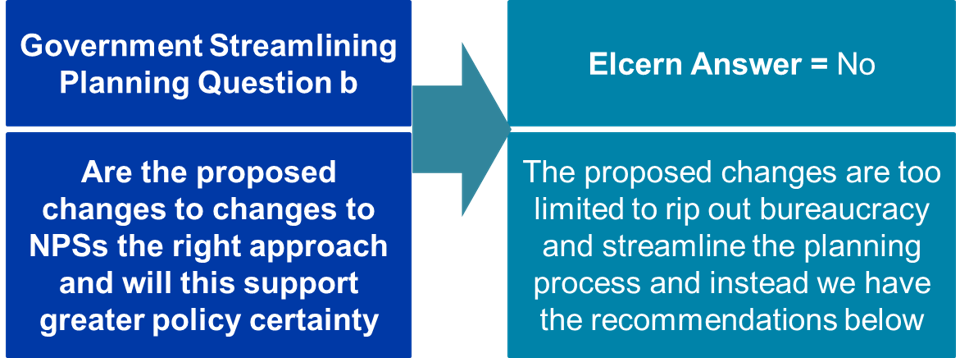
In our response to the public planning consultation, we aimed to provide support the Ministry streamline the National Policy Statements in a way that might enable faster decision-making in a fair and certain process.
Fundamentally, our answer to the Ministry's consultation question was as follows:
Context
The government described its NPSs as providing a framework within which recommendations on Nationally Significant Projects can be made to the Secretary of State. They set out the government's objectives for the development of nationally significant infrastructure in a particular sector. They express how government policy relating to the mitigation of and adaptation to climate change is to be taken into account. They consider issues related to safety or technology; any adverse impacts of development, set specific locations where appropriate and how actual and projected capacity and demand are taken into account.
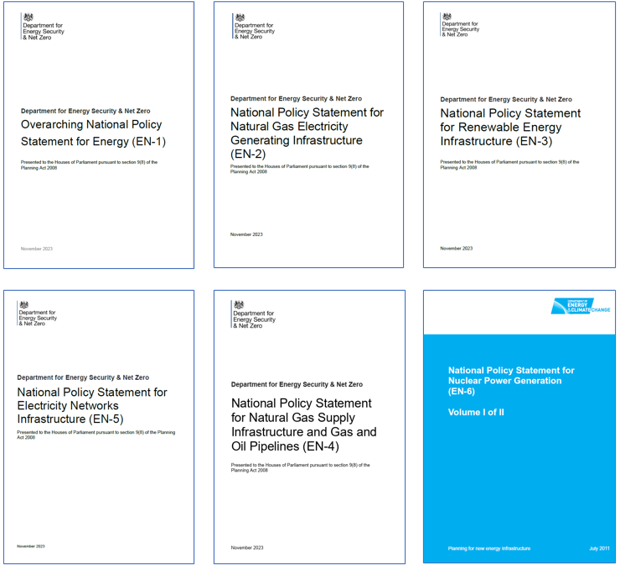
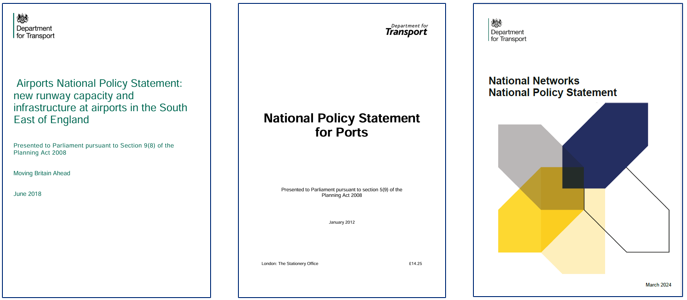
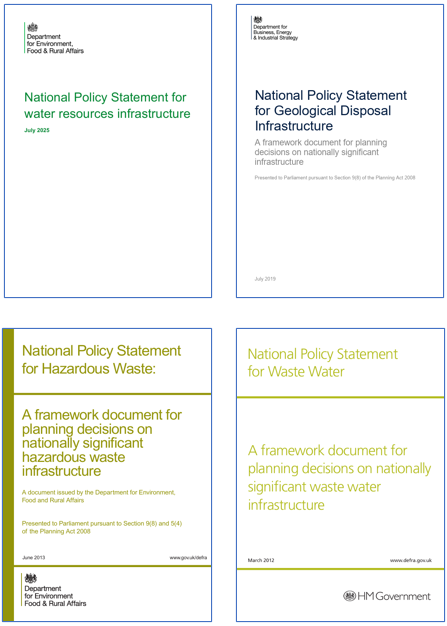
The current set of 13 NPSs address three sectors as follows: energy (6 NPSs), transport (3 NPSs) and water/waste (4 NPSs).
For energy, the current NPSs are: (see inserts)
The current 3 transport NPSs are: (see insert)
The current 4 water/waste NPSs: (see insert)
Issues and Recommendations
1. There’s an urgent need for a data centre NSP
Current UK government guidance on investment in huge critical facilities is in our opinion inadequate. The UK government has openly described the slow process for permitting land for new projects, and how the electricity connections process is beset by long queues that without interventions may slow developments by years not months.
Permitting land for development is devolved to UK local authorities. A number of development proposals have been rejected by those local authorities. In some cases, central government has "called in" the proposal for consideration by the Secretary of State. That consideration has resulted in a central approval for the development to move ahead. One reason for such a reversal has been the UK national interest.
The government “calling in” locally rejected proposals adds to a lengthy process, Even with central government’s classification of data centres as critical national infrastructure, the Deputy Prime Minister continues to “call in” data centre projects that were rejected locally. Some £40+bn of investment is currently targeted at developing UK data centres that may be critical to UK economic growth.
In our view, unnecessary bureaucracy of "calling in" data centre applications might be avoided or minimised by government equipping developers and planning committees with sufficient guidance.
Government objectives for the development of nationally significant infrastructure in a particular sector has been set out in National Policy Statements (NPSs). The NSPs set guidance for how a development contributes to sustainable development, integrates with other government policies, accounts for actual and projected capacity and demand, safety and technology aspects, adverse impacts and any specific location points.
In our view an NSP for data centres should be created. Past content of NSPs seems an ideal place to set guidance that might speed consideration of data centre proposals. To date, the government NSPs have addressed three sectors: energy, transport and water/waste.
That guidance should target the boom in data centre planning applications that may be core to the government’s economic mission. Government could issue such guidance in an NSP for data centres. Data centre funders, developers and operators would then follow that guidance within planning applications, and most crucially, local planners could then confirm their assessments versus that guidance.

2. NPS documentation is badly dated versus government strategies and targets and government’s proposed fix isn’t sufficient
NPS publication dates ranged from 2011, 2012, 2013, 2018 and 2019 (see tabular summary).
The requirement stated in Section 6 of the Planning Act 2008 is: “the Secretary of State must review each NPS whenever the Secretary of State thinks it is appropriate to do so”. In practice, government guidance for the minimum period for review was variable.
The government's wrapper webpage that gave navigation to each current NPS as of its July 2025 update made no mention of the review process for individual NPSs. Instead, the Section 6 requirement above occurred with different wordings by government in each NPS.
The most recent individual NPS update (that of the water infrastructure NPS in July 2025) gave a typical example of the wordings found.
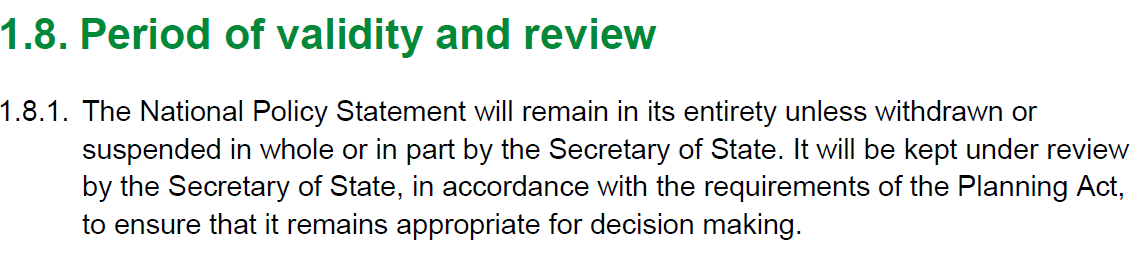
The overarching NPS for Energy (ENE-1) guided that “it will be subject to review by the Secretary of State in order to ensure that is remains appropriate". The energy NPSs for gas-fired power generation (ENE-2), renewable energy infrastructure (ENE-3), gas and oil pipelines (ENE-4) and electricity networks (ENE-4) followed suit by each having a clause on the minimum review period clause that directed the reader to ENE-1. The nuclear energy NPS (ENE-6) was quite different (see extract below)
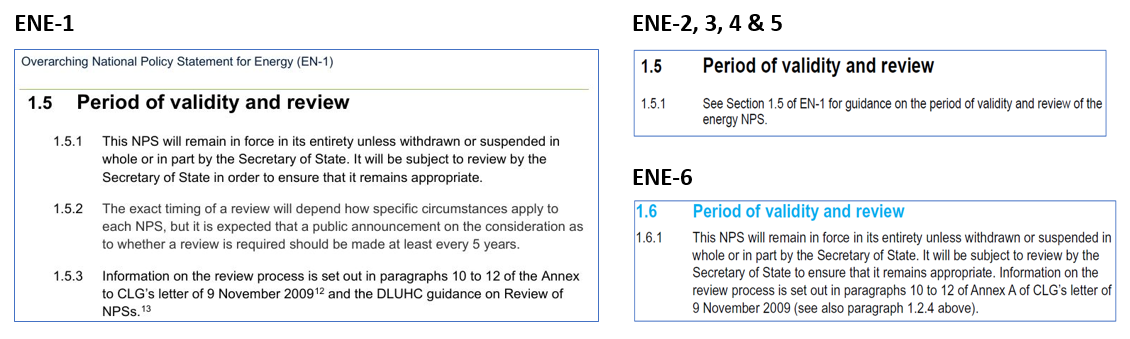
No overarching NPS was provided by the UK government for its transport NPSs. The wording used for the minimum review period varied widely across those 3 transport NPSs (see insert).
No overarching NPS is provided by the UK government for its water/waste NPSs. The wording used for the minimum review period varied widely across those 4 water/waste NPSs (see insert).
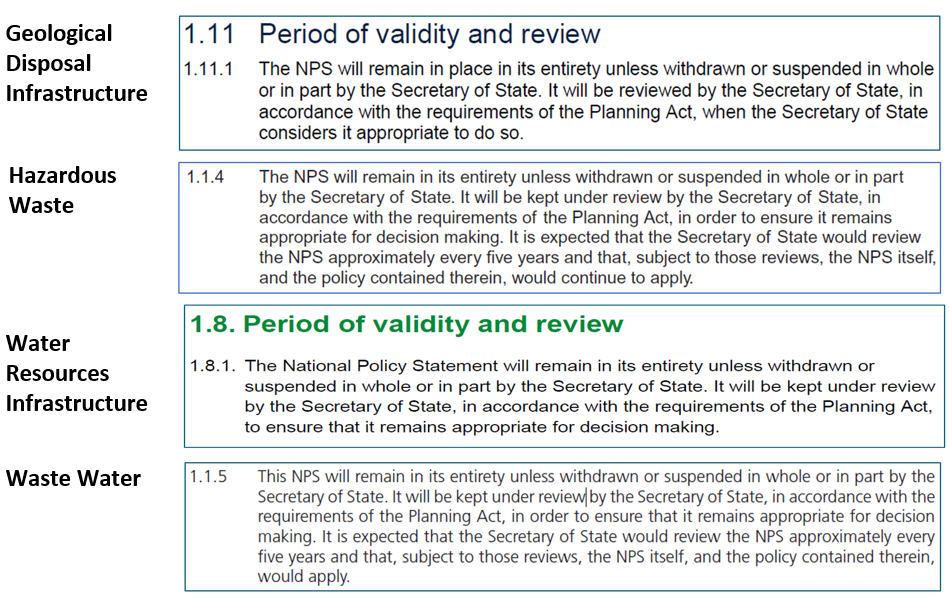
Most recent government intentions to update NPSs every 5 years lie beyond general elections and almost certainly miss changes in strategies, priorities, national and international issues possibly making NPSs untenable. One simple example is guidance on coal-fired power generation in ENE-1.
Also, on content, DESNZ’s November 2023 energy EN-1 NPS guided on coal, in opposition to its Clean Power 2030 Action Plan which aims to “clean up a dysfunctional grid system by prioritising the most important projects”, “speeding up decisions on planning permissions by empowering planners to prioritise critical energy infrastructure”.

3. NPS documentation is complex and burdensome and urgently needs simplification in order to support developers and planners
NPS documentation contains unnecessarily complex variations of terminology around the critical “environment” area. Meeting government’s environmental targets, particularly as recently reset, is a critical aspect of planning and in our opinion should be authoritatively and simply defined.
As evidence, generic administrative information like “What are NPS” is in 6 Energy NPSs but not in the Ports NPS. We recommend that such generic guidance is ripped out of each NPS and instead goes in an overarching NPS. Simpler authoritative user documentation and less review requirements result.
Also, technical risk assessment tools/processes occur in variable language, length and content across NPSs e.g. for flood risk. Such tools/process guidance is already regulations and the National Risk Register.
Also, the critical environment content is overly complicated by language, content and length variations across NPSs. As evidence, across the three NPSs in the water/waste area environment was described using 13 sections, which we have grouped into the following 8 themes:
- Air quality and emissions;
- Biodiversity and geological conservation;
- Environmental Impact Assessment,
- Environmental Net Gain and Environmental Regulation;
- Climate change mitigation - greenhouse gas emissions and Climate change adaptation;
- Habitats considerations, Interaction with the Habitats Directive and Habitats Regulations Assessment;
- Pollution control and other environmental consenting regimes;
- The appraisal of sustainability and Sustainability considerations.
In our view, environment aspects within all NPSs could be simplified and made authoritative. A simpler, smaller set of key sub-title words could be selected, with their generic aspects and explained in the overarching NPS (see other answers for further considerations for the overarching NPS we propose). That overarching NPS could set out critical government environmental targets in a single, up to date and authoritative way. We would be happy to share further evidence of how the 13 variations for environment are used across the current set of NPSs

4. NPSs aren’t all in Welsh language and should be to better support developers and planners
As evidence, whilst the NPS guidance webpage stated NPSs apply to Wales only one of the 13 NPSs (the Airports NPS) was available to users in Welsh language. That status may not align with central government commitments and slow planning.

5. NPS scope gaps lack simple directions for how funders, designers and operators can proceed in their critical infrastructure planning application
The scope of each NPS was not precisely stated as to what was covered and what was not. For example, the airport NPS limited itself to “South East England” addressing Heathrow Northwest and Extended Northern runways and Gatwick Second Runway specifically, yet stated “Other NPSs may also be relevant to decisions on airport capacity in this geographical area”. Furthermore, over £4.6bn of investment at other airports in England may go through other planning routes. The evidence is London Gatwick (£2.2 bn), Stansted (£1.1bn), Manchester Airport (£1.3bn), London Luton, with airports at London Southend, Doncaster Sheffield also potentially adding to this.
Direction is needed within each NPS to where planning guidance over excluded scope items is available – for instance, where guidance for northern England airports will be found by NPS users. Our recommendation does not solely concern airports, but also the energy and water/waste NPSs, and we would be happy to share such further evidence.

6. NPS documentation is overly lengthy for users to digest and reviewers to review and there are simple ways to shorten them
As evidence, the current NPSs overall totalled 1,361 pages; energy (730 pages), transport (278) and water/waste (353). Page count is of course somewhat of a blunt metric. Yet it does expose the task of consuming and implementing for developers and planning committees. In addition, it represents a daunting task for review, even per NPS, let alone per infrastructure area.
Perhaps unsurprisingly, the nuclear generating plant NPS has the most pages; indeed over three times the count of NPSs in other infrastructure areas. The average page count is 85 pages (excluding nuclear). Eight of the NPSs are below 100 pages (see Table 2).
The key question is the extent to which the rules are clear within each NPS document
If the NPS regime is extended to address additional critical infrastructure the planning task gets ever greater.

7. NPS Landscape/visual impact statements in our opinion do not readily turn into specific criteria for designers/decision makers but should do so
As evidence, the Hazardous Waste NPS wants materials and building designs to be always carefully considered, which we consider is a given and hard to turn into a judgement criterion.

Summary
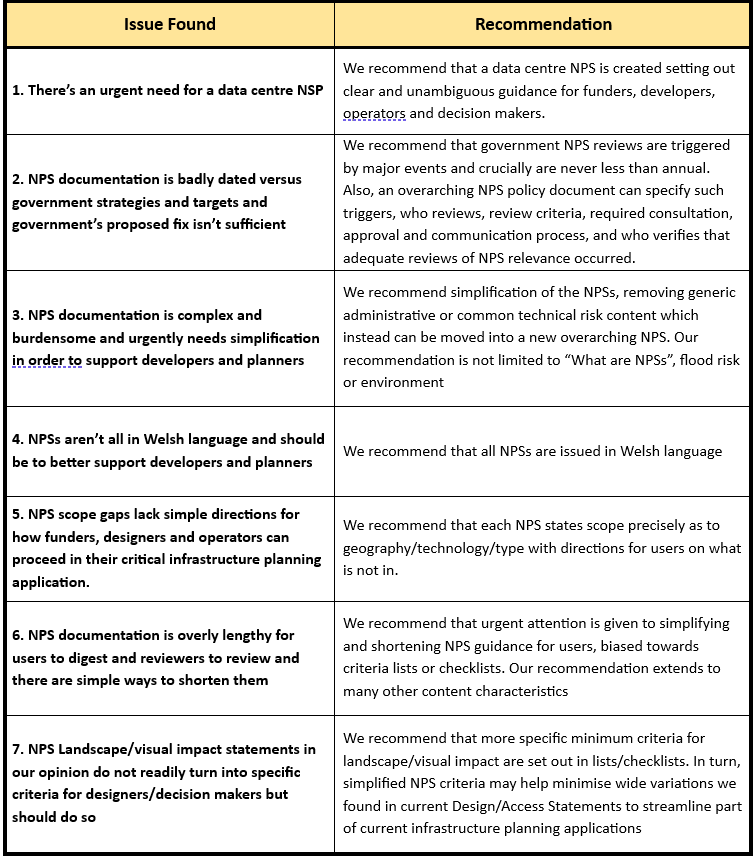
Overall our 7 recommendations to the UK government were shaped as follows:
Why Elcern Consulting Responded to the Consultation
Elcern Consulting is a boutique management consultancy that over the last five years has focussed on supporting data centre funders, developer, constructors, operators and customers. Within those five years we have seen huge friction build up in the planning process for new data centres. Given the critical importance of data centre to the UK economy under the new government, we aim to provide key insights on how data centres can navigate the planning process. Our consultation response is one of a series we are doing to support the streamlining and fairness of data centre planning processes.
DISCLAIMER = The above research was prepared solely for an initial, draft, high-level perspective, based upon brainstorming sessions. It should not be taken as accurate or complete. It is purely a basis for discussion, relating only to its preparation date. Recipients should conduct their own research to reach any conclusions, decisions or actions.